Heart Health™ Essential Omega III Fish Oil with Vitamin E: Bonaa, KH, et al, Effect of eicosapentaenoic and docosahexaenoic acids on blood pressure in hypertension. A population-based intervention trial from the Tromso study. N Engl J Med 322(12):795-801 (1990)
Chan JK, et al, Dietary alpha-linolenic acid is as effective as oleic acid and linoleic acid in lowering blood cholesterol in normolipidemic men. Am J Clin Nutr 53(5):1230-1234 (1991)
Garrido A, et al, Ingestion of high doses of fish oil increases the susceptibility of cellular membranes to the induction of oxidative stress. Lipids 24(9):833-835 (1989)
Harris WS, et al, Dietary omega-3 fatty acids prevent carbohydrate-induced hypertriglyceridemia. Metabolism 33(11):1016-1019 (1984)
Howe PR. Dietary fats and hypertension. Focus on fish oil. Ann NY Acad Sci 827:339-352 (1997)
Knapp HR, FitzGerald GA. The antihypertensive effects of fish oil. A controlled study of polyunsaturated fatty acid supplements in essential hypertension. J Engl J Med 320(16):1037-1043 (1989)
Kris-Etherton PM, et al, fish consumption, fish oil, omega-3 fatty acids, and cardiovascular disease. Arterioscler Thromb Vasc Biol 23(2):e20-e30 (2003)
Madsen T, Skou HA, et al, C-reactive protein, dietary n-3 fatty acids, and the extent of coronary artery disease. Am J Cardiol 88:1139-42 (2001)
Morris MC, et al, The effect of fish oil on blood pressure in mild hypertensive subjects: a randomized crossover trial. Am J Clin Nutr 57(1):59-64 (1993)
Morris, MC, Sacks F, Rosner B. Does fish oil lower blood pressure? A meta-analysis of controlled trials. Circulation 88(2):523-533 (19930
Nestel PJ. Fish oil attenuates the cholesterol induced rise in lipoprotein cholesterol. Am J Clin Nutr 43(5):752-757 (1986)
Rigelsky, JM, et al, Hawthorn: pharmacology and therapeutic uses. Am J Health Syst Pharm 59:417-22 (2002)
Tsai PJ, Lu SC. Fish oil lowers plasma lipid concentrations and increases the susceptibility of low density lipoprotein to oxidative modification in healthy men. J Formos Med Assoc 96(9):718-726 (1997)
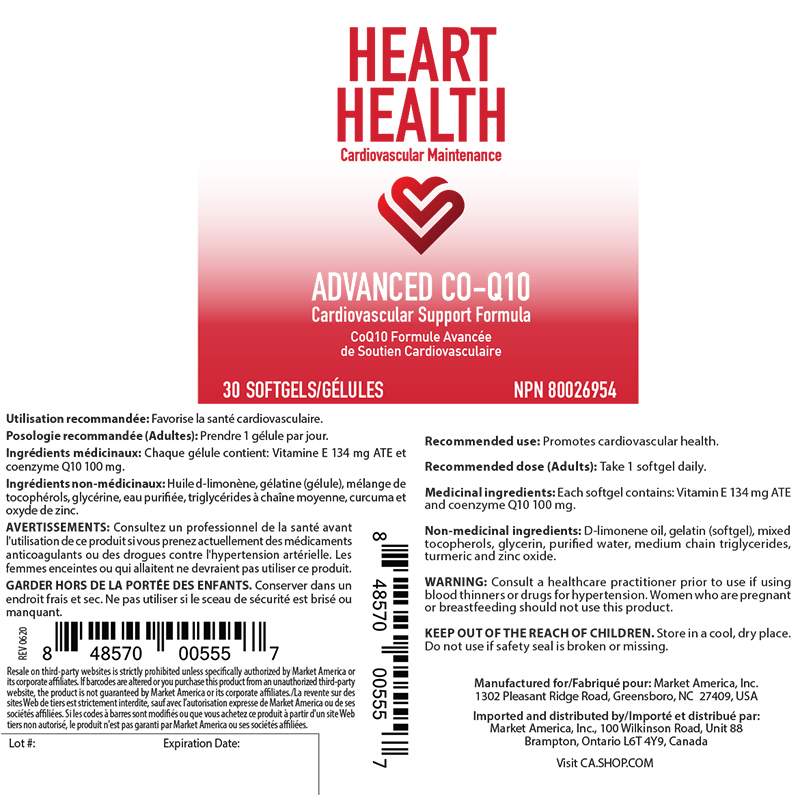
Heart Health™ Advanced Co-Q10 (Cardiovascular & Immune Support): Chello, M, et al. Protection of coenzyme Q10 from myocardial reperfusion injury during coronary artery bypass grafting. Annals of Thoracic Surgery 58: 1427-1432, 1994.
Chen Y.F., Lin Y.T. and Wu S.C. Effectiveness of coenzyme Q10 on myocardial preservation during hypothermic cardioplegic arrest. Journal of Thoracic and Cardiovascular Surgery 107: 242-247, 1994.
Digiesi, V. et al. Mechanism of action of coenzyme Q10 in essential hypertension. Current Therapy and Research 51: 668-672, 1992.
Firstein, R. The Nutraceutical Revolution. New York, Riverhead Books, 1998.
Folkers, K. et al. Effect of coenzyme Q10 on serum levels of creatine phosphokinase in preclinical muscular dystrophy. Proceedings of the National Academy of Sciences USA 71: 2098, 1974.
Folkers, K. et al. Biochemical rationale and the cardiac response of patients with muscle disease to therapy with coenzyme Q10. Proceedings of the National Academy of Sciences USA 82: 4513, 1985.
Folkers, K et al. The activities of coenzyme and vitamin B6 for immune responses. Biochemical and Biophysical Research Communications 193: 88-92, 1993.
Folkers, K et al. Coenzyme Q10 increases T4/T8 ratios of lymphocytes in ordinary subjects and relevance to patients having the AIDS-related complex. Biochemical and Biophysical Research Communications 176: 25.
Frei, B, et al. Ubiquinol-10 is an effective lipid-soluble antioxidant at physiological concentrations. Proceedings of the National Academy of Sciences USA 87: 4879-4883, 1990.
Greenberg, S. and Frishman, W.H. Coenzyme Q10: A new drug for cardiovascular disease. Journal of Clinical Pharmacology 30: 596-608, 1990.
Greenburg S. and Frishman W. Coenzyme Q10: A new drug from myocardial ischemia? Medical Clinics of North America 72: 243-58, 1998.
Hanaki, Y. et al. Ratio of low-density lipoprotein cholesterol to ubiquinone as a coronary risk factor: New England Journal of Medicine, 325: 814-815, 1991.
Kagan, V, et al. Coenzyme Q: Its role in scavenging and generation of radicals in membranes. In Handbook of Antioxidants, eds. Enrique Cadenas and Lester Packer, New York, Marcel Dekker, Inc., 1996, pp. 157-201.
Langsjoen, P.H. et al. Pronounced increase of survival of patients with cardiomyopathy when treated with coenzyme Q10 and conventional therapy. International Journal of Tissue Reactions 12: 163-168, 1990.
Langsjoen, P.H. et al. A six-year clinical study of therapy of cardiomyopathy with coenzyme Q10. International Journal of Tissue Reactions 12: 169-71, 199.
Lansjoen, P.H. et al. Response of patients in classes III and IV of cardiomyopathy to therapy in a blind crossover trial with coenzyme Q10. Proceedings of the National Academy of Sciences USA 82: 4240, 1985.
Littarru, G.P. et al. Deficiency of coenzyme Q10 in gingival tissue from patients with periodontal disease. Proceedings of National Academy of Sciences USA 68: 2332, 1971.
Littarru, G.P. et al. Clinical aspects of coenzyme Q: Improvement of cellular bioenergetics or antioxidant protection? In Handbook of Antioxidants, eds. E. Cadenas and L. Packer: New York, Marcel Dekker, Inc., 1996, pp. 203-239.
Lockwood, K. et al. Partial and complete regression of breast cancer in patients in relation to dosage of Coenzyme Q10. Biomedical and Biophysical Research Communications 199: 1504-1508, 1994.
Murray, M.T. Encyclopedia of Natural Medicine, Rocklin, CA, Prima Publishing, 1998.
Nakamura, R. et al. Study of Co Q10-enzymes in gingival tissues from patients with periodontal disease and evidence for a deficiency of coenzyme Q10. Proceedings of the National Academy of Sciences USA 71: 1456, 1974.
Shi, H. and Noguchi, N. Dynamics of antioxidant action of ubiquinol: A reappraisal. Biofactors 9: 141-148, 1999.
Singh R.B. and Singh M.M. Effects of coenzyme Q10 in new indications with antioxidant vitamin deficiency. Journal of Nutritional and Environmental Medicine 9: 223-228, 1999.
Stocker, R. et al. Ubiquinol-10 protects human low density lipoprotein more efficiently against lipid peroxidation than does alpha-tocopherol. Proceedings of the National Academy of Sciences USA 88: 1646-1650, 1991.
Stryer, L. Biochemistry, 2nd ed. New York, W.H. Freeman and Company, 1981.
Sunamori, M. et al. Clinical experience of coenzyme Q10 to enhance intraoperative myocardial protection in coronary artery revascularization. Cardiovascular Drugs and Therapy 5: 297-300, 1991.Chello, M, et al. Protection of coenzyme Q10 from myocardial reperfusion injury during coronary artery bypass grafting. Annals of Thoracic Surgery 58: 1427-1432, 1994.
Chen Y.F., Lin Y.T. and Wu S.C. Effectiveness of coenzyme Q10 on myocardial preservation during hypothermic cardioplegic arrest. Journal of Thoracic and Cardiovascular Surgery 107: 242-247, 1994.
Digiesi, V. et al. Mechanism of action of coenzyme Q10 in essential hypertension. Current Therapy and Research 51: 668-672, 1992.
Firstein, R. The Nutraceutical Revolution. New York, Riverhead Books, 1998.
Folkers, K. et al. Effect of coenzyme Q10 on serum levels of creatine phosphokinase in preclinical muscular dystrophy. Proceedings of the National Academy of Sciences USA 71: 2098, 1974.
Folkers, K. et al. Biochemical rationale and the cardiac response of patients with muscle disease to therapy with coenzyme Q10. Proceedings of the National Academy of Sciences USA 82: 4513, 1985.
Folkers, K et al. The activities of coenzyme and vitamin B6 for immune responses. Biochemical and Biophysical Research Communications 193: 88-92, 1993.
Folkers, K et al. Coenzyme Q10 increases T4/T8 ratios of lymphocytes in ordinary subjects and relevance to patients having the AIDS-related complex. Biochemical and Biophysical Research Communications 176: 25.
Frei, B, et al. Ubiquinol-10 is an effective lipid-soluble antioxidant at physiological concentrations. Proceedings of the National Academy of Sciences USA 87: 4879-4883, 1990.
Greenberg, S. and Frishman, W.H. Coenzyme Q10: A new drug for cardiovascular disease. Journal of Clinical Pharmacology 30: 596-608, 1990.
Greenburg S. and Frishman W. Coenzyme Q10: A new drug from myocardial ischemia? Medical Clinics of North America 72: 243-58, 1998.
Hanaki, Y. et al. Ratio of low-density lipoprotein cholesterol to ubiquinone as a coronary risk factor: New England Journal of Medicine, 325: 814-815, 1991.
Kagan, V, et al. Coenzyme Q: Its role in scavenging and generation of radicals in membranes. In Handbook of Antioxidants, eds. Enrique Cadenas and Lester Packer, New York, Marcel Dekker, Inc., 1996, pp. 157-201.
Langsjoen, P.H. et al. Pronounced increase of survival of patients with cardiomyopathy when treated with coenzyme Q10 and conventional therapy. International Journal of Tissue Reactions 12: 163-168, 1990.
Langsjoen, P.H. et al. A six-year clinical study of therapy of cardiomyopathy with coenzyme Q10. International Journal of Tissue Reactions 12: 169-71, 199.
Lansjoen, P.H. et al. Response of patients in classes III and IV of cardiomyopathy to therapy in a blind crossover trial with coenzyme Q10. Proceedings of the National Academy of Sciences USA 82: 4240, 1985.
Littarru, G.P. et al. Deficiency of coenzyme Q10 in gingival tissue from patients with periodontal disease. Proceedings of National Academy of Sciences USA 68: 2332, 1971.
Littarru, G.P. et al. Clinical aspects of coenzyme Q: Improvement of cellular bioenergetics or antioxidant protection? In Handbook of Antioxidants, eds. E. Cadenas and L. Packer: New York, Marcel Dekker, Inc., 1996, pp. 203-239.
Lockwood, K. et al. Partial and complete regression of breast cancer in patients in relation to dosage of Coenzyme Q10. Biomedical and Biophysical Research Communications 199: 1504-1508, 1994.
Murray, M.T. Encyclopedia of Natural Medicine, Rocklin, CA, Prima Publishing, 1998.
Nakamura, R. et al. Study of Co Q10-enzymes in gingival tissues from patients with periodontal disease and evidence for a deficiency of coenzyme Q10. Proceedings of the National Academy of Sciences USA 71: 1456, 1974.
Shi, H. and Noguchi, N. Dynamics of antioxidant action of ubiquinol: A reappraisal. Biofactors 9: 141-148, 1999.
Singh R.B. and Singh M.M. Effects of coenzyme Q10 in new indications with antioxidant vitamin deficiency. Journal of Nutritional and Environmental Medicine 9: 223-228, 1999.
Stocker, R. et al. Ubiquinol-10 protects human low density lipoprotein more efficiently against lipid peroxidation than does alpha-tocopherol. Proceedings of the National Academy of Sciences USA 88: 1646-1650, 1991.
Stryer, L. Biochemistry, 2nd ed. New York, W.H. Freeman and Company, 1981.
Sunamori, M. et al. Clinical experience of coenzyme Q10 to enhance intraoperative myocardial protection in coronary artery revascularization. Cardiovascular Drugs and Therapy 5: 297-300, 1991.
Prime™ Astaxanthin Antioxidant & Ocular Support Formula: Camera, E., et al. Astaxanthin, canthaxanthin and beta-carotene differently affect UVA-induced oxidative damage and expression of oxidative stress-responsive enzymes. Exp Dermatol. 18(3):222-31, 2009.
Ikeuchi, M., et al. Effects of astaxanthin supplementation on exercise-induced fatigue in mice. Bio. Pharm. Bull. 29(10):2106-2110, 2006.
Karppi, et al . Effects of astaxanthin supplementation on lipid peroxidation. Int J Vitam Nutr. Jan; 77 (1): 3-11, 2007.
Malmsten, C. and Lignell, A. Dietary supplementation with astaxanthin rich algal meal improves muscle endurance – a double blind study on male students. Carotenoid Science. 13:20-22, 2008.
Matsuyama, et al . A safety study on the long-term consumption of astaxanthin in healthy human volunteer. Japanese Journal of Complementary and Alternative Medicine. (7):43-50, 2010.
Miyawaki, et al . Effects of astaxanthin on human blood rheology. Journal of Clinical Therapeutics and Medicines. 21(4):421-429, 2005.
Nagaki, Y., et al. Effects of astaxanthin on accommodation, critical flicker fusion, and pattern visual evoked potential in visual display terminal workers. Journal of Traditional Medicines. 19: 170-173, 2002.
Nagaki, Y., et al. Effects of astaxanthin on retinal capillary blood flow in normal volunteers. Journal of Clinical Therapeutics and Medicines. 21(5): 537-542, 2005.
Naguib, Y. The antioxidant activities of astaxanthin and related carotenoids. Journal of Agricultural and Food Chemistry. 48(4): 1150-1154, 2000.
Nakagawa, et al . Antioxidant effect of astaxanthin on phospholipid peroxidation in human erythrocytes. British Journal of Nutrition. (31):1-9, 2011.
Nakamura, A., et al. Changes in visual function following peroral astaxanthin. Japanese Journal of Clinical Ophthalmology. 58(6): 1051-1054, 2004.
Satoh, et al. Preliminary clinical evaluation of toxicity and efficacy of a new astaxanthin-rich Hameotoccus pluvialis . J. Clin. Biochem. Nutr. 44: 280–284, 2009.
Sawaki, K., et al. Sports performance benefits from taking natural astaxanthin characterized by visual activity and muscle fatigue improvements in humans. J. Clin. Ther. Med. 18(9):73-88, 2002.
Yamashita, et al. Cosmetic benefit of the supplement health food combined astaxanthin and tocotrienol on human skin. Food Style. 21. 6(6):112-117, 2002.
Yamashita, et al. The Effects of a Dietary Supplement Containing Astaxanthin on Skin Condition. Carotenoid Science. 10:91-95, 2006.